|
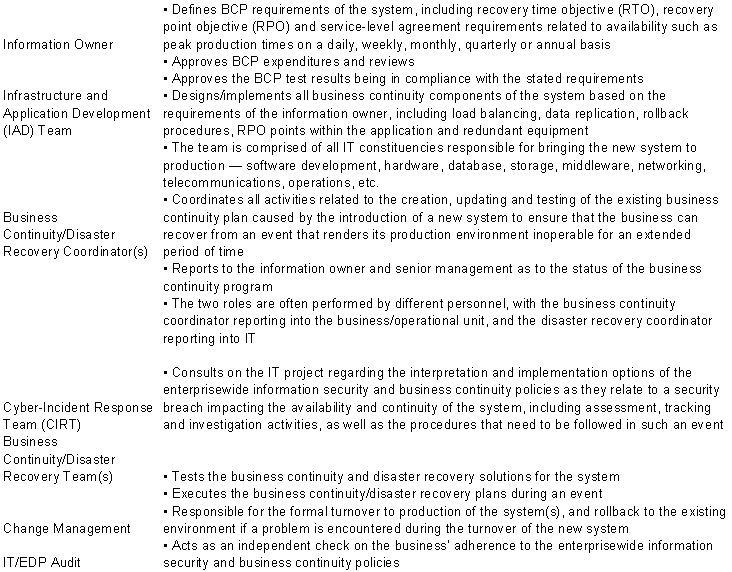
Source: Gartner Research
This Research Note is written from an IT project perspective,
and therefore does not address all BCP activities, such as the creation of
a business continuity policy, business continuity organization, crisis
management team or personnel evacuation/management plans. For a model that
addresses all BCP activities, refer to the Business Continuity Planning
Model by DRJ.com at www.drj.com. However, all such components should be
reviewed and updated if required to meet the business continuity
requirements of the systems being developed by the IT project.
Business Requirements: The goal of the first phase of the PLC is
for business management to identify the high-level, business-related
continuity requirements for the new IT system(s). Activities to be
completed during this first PLC phase include:
- Business impact analysis (BIA)
- Risk analysis (RA) for the business as a result of using the new
system(s)
- The recovery time objective (RTO)
- Recovery point objective (RPO)
- A review of the impact of the new system(s) on existing business
processes and systems. This review will ensure that the business
continuity requirements can be supported throughout the entire
processing stream. Changes may be required in supporting or
interdependent business processes and systems that will mean additional
design, development, implementation and funding not anticipated when
viewed only from the new system(s) perspective.
In an example of business continuity requirements, the system will be
used by front-office personnel such as traders and trader assistants for
trade entry, back-office operations for execution and risk management for
credit and risk assessment. It must be available from Sunday evening 7
p.m. EST through Friday 9 p.m. EST, because the trading book is global.
The system must be available within one hour for a single component outage
and within four hours of an outage, with no loss of data, for a
multicomponent or site outage; therefore, the system must be designed for
no single point of failure.
In addition to business management, often referred to as the
information owner, other participants in BCP for this first PLC phase
include: the Infrastructure and Application Development (IAD) team, the
business continuity/disaster recovery coordinator(s), the cyber-incident
response team (CIRT) and the audit department.
System Architecture: The goal of the second phase of the PLC is
to establish a system and business process architecture that supports the
business continuity requirements for the new system(s), interdependent
systems and associated business processes. In the second phase of the PLC,
the following activities are completed:
- Scenario(s) under which the plan will be executed
- Business continuity strategy alternatives development
- Cost/benefit analysis of each alternative
- Selection of the best business continuity strategy
Participants in the second PLC phase include the information owner, the
IAD team, IT operations, the business continuity/disaster recovery
coordinator(s) and the CIRT.
System Design: The third phase of the PLC will draw upon all
participants of the BCP process with the goal of developing a detailed
design and set of specifications for the system(s) in support of the
business continuity requirements for the new system(s), as well as
supporting/interdependent business processes and systems. The
recovery of the system(s) after the emergency event, as well as its
restoration to the production site, must be considered. Activities
to be completed in this third PLC phase include:
- Business continuity/disaster recovery team(s)/responsibilities
identification, including the party responsible for maintaining the
business continuity plan itself
- Technical components/architecture design
- Business processes design
- Escalation, notification and plan activation strategy
- Vital records/off-site storage program
- High-level test strategy
Construction: In this step, the enterprise builds the disaster
recovery and business continuity plans and technical components in support
of the business continuity requirements. Activities to be completed in
this fourth PLC phase include:
- Emergency response procedures
- Personnel call trees
- Technical disaster recovery infrastructure, including systems and
telecommunications
- Recovery and restoration procedures
- Vendor selection and contracts for purchased recovery services
(e.g., outsourced recovery service providers or off-site storage)
- Detailed business continuity test plan
All business continuity participants should be involved in the
activities of this fourth PLC phase.
Testing: The fifth PLC phase is one of the most important phases
in the overall IT project — ensuring that what was designed and built
meets the RTO/RPO as defined by the business in the first phase. Testing
also ensures that the business continuity/disaster recovery team(s) is
trained in the recovery of the system(s). Using the business continuity
test plan, activities to be completed in this fifth PLC phase include:
- Recovery and restoration procedures walk-through, i.e., a tabletop
test
- Emergency response procedures execution
- Personnel call tree execution
- Recovery and restoration procedures execution, where feasible. If
the IT project and associated new systems are mission-critical, a
complete execution of the business continuity plan may be warranted. If
not feasible, then a date must be selected, no more than three months
after the implementation date, when the business continuity plans will
be tested — separately or as part of a larger business continuity test.
- Immediately after the test, a report must be issued to the
information owner regarding all areas where the business continuity
strategy does not meet the requirements. A plan must be developed that
identifies who is responsible for closing the gap, and by when. It must
be noted in this report the date when the gap resolution will be tested,
if applicable.
It is important to consider the impact on customers during the test —
you might include them as well as external interdependencies to ensure
that the entire business process can be successfully recovered.
Implementation: During this sixth PLC phase, change management
promotes application software to production, and IT infrastructure
personnel implement hardware and telecommunications into the production
environment. It is often prudent to perform a second test of the disaster
recovery IT infrastructure after implementation, especially when using an
outside service provider for IT operations.
Maintenance: All major changes to the system(s) must include a
review of the business continuity strategy and plans to ensure that they
still meet the requirements as defined by the information owner. Such
changes must cycle through all BCP activities in each PLC phase through
implementation to ensure that the system(s) will be recoverable.
Retirement: When the system(s) is
no longer required, the takedown of the disaster recovery and business
continuity environment must be completed. Activities to be completed in
this last PLC phase include:
- Disablement of the disaster recovery IT infrastructure
- Destruction of emergency response procedures, recovery and
restoration procedures, and personnel call trees
- Cancellation of all vendor contracts
- Destruction of off-site storage, according to regulatory retention
requirements. Not all off-site storage can be destroyed when no longer
needed for current production business processing — those controlled by
regulatory agencies such as revenue/tax agencies must be available for
restoration purposes in the event of a regulatory or legal dispute.
Confer with the legal department to determine the long-term retention
requirements for your industry and enterprise.
Enterprises that simply add BCP to system(s) already designed or
implemented expose themselves to unnecessary risks ranging from the minor
customer annoyance to the loss of revenue from customers going to a
competitor to outright stoppage of its business. Enterprises that
incorporate BCP into system(s) from the beginning will enjoy a competitive
advantage that will manifest itself in fewer disruptions to enterprise
operations, and in greater confidence from customers, partners and
suppliers.
This research is part of a broader article consisting of a number of
contemporaneously produced pieces. See
COM-13-6392
on www.gartner.com for an overview of the
article. |