|
|
| |
| Building an RFP for Business Continuity Services | |||
| 27 August 1999 | |||
| Simon
Mingay | |||
| We outline what needs to go into an
RFP when assessing potential providers of BC and disaster recovery
services. | |||
| |||
| ||||||||||||||
|
||||||||||||||
| ||||||||||||||
|
|
| ||
Building an RFP for Business Continuity Services | ||||
|
|
| |
|
We outline what needs to go into an RFP when assessing potential providers of BC and disaster recovery services. | |||
|
|
| |
| Bottom
Line | |||
|
|
| |
|
| |||
|
|
| |
| Key Issue What process should an enterprise follow to select the best ESPs for its specific needs in Europe? | |||
|
|
| |
|
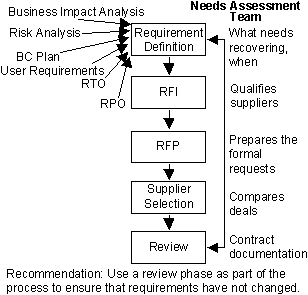
We outline a framework for developing RFPs for BC services, which are becoming increasingly complex. Mission and scope: The RFP is used to detail the solution an enterprise wants to implement, and to evaluate vendor proposals in a systematic and consistent manner (see Figure 1). The RFP is not used to gain education on potential solutions or vendors; this is achieved through an RFI. The RFP is used to help qualify the ESP and the ESP’s proposal. RFPs should be detailed, and therefore are long. While the RFP is part of the legal document trail, nothing is final until a contract is negotiated and signed. | |||
|
|
| |
Figure 1 The Acquisition Process
Source: GartnerGroup | |||
|
|
| |
|
Control and distribution: There should be extensive internal reviews and approvals of RFPs (see Note 1). Copies of all RFPs should be maintained in a central location for reference. Version control is important as a formal means of document tracking, and ensures that users and vendors are working from the same document. Distribution should be selective and based on market research and an RFI process. Only vendors that can provide a quality solution should be included. The number of vendors should be limited to three. | |||
|
|
| |
Note 1 Review The review should involve representatives from groups with responsibility for each component of the solution, as well as procurement. Some organizations may also need to involve financial controllers, legal council and internal auditors to comply with internal policy. | |||
|
|
| |
|
Position in the acquisition process: The RFP should be sent out only after the BC plan contains sufficient detail to enable the detailed specification of requirements (see Note 2), or, at the very least, when there is a clear idea about what needs recovering and when. Vendor-proposal evaluation and additional investigation (e.g., calling references and performing financial due diligence) will determine which ESP’s solution will be selected. This information is then put into the recommendation. Below is a basic RFP checklist: | |||
|
|
| |
Note 2 Just a List of Equipment The IS group is frequently under time pressure. The result is that it simply passes the list of equipment it has to the vendor and invites a proposal. This usually results in the enterprise spending four to 10 times more than it needs as a result of covering too much equipment in too tight a time schedule. | |||
|
|
| |
| |||
|
|
| |
Note 3 RTO and RPO RTO is the time window within which the process or system must have its minimal functionality. RPO is the point in time up to which consistent data can be recovered. | |||
|
|
| |
Note 4 Recovery Time Line Typically some 20 percent to 40 percent of capacity is required within the first 48 hours, with the rest coming online in subsequent weeks. Demanding full capacity within the first 24 or 48 hours reduces the flexibility of the vendor to create a more suitable response and increases cost substantially. A recovery time line describes how capacity requirements change over time. | |||
|
|
| |
Note 5 Test Scheduling Test slots are the resource bottleneck for BC vendors. The RFP should lay out the requirements for testing, including first-year requirements, which platforms need to be tested together, and for how much time. The RFP should specify the deadline for having a working recovery process. | |||
|
|
| |
| |||
|
|
| |
Note 6 Length of Contract Contracts should be kept to three years. Vendors make most of their money toward the end of the contract as their cost of operation per MIPS, per gigabyte and so on decreases year on year. For the client enterprise to realize this saving it needs to keep the contract to three years and then enter another tendering process. | |||
|
|
| |
Note 7 Price Breakdown Prices should be broken down by each category of service (workspace, network services) and for the technology services by platform group (e.g., AS400s, HP9000s). Where reasonable to do so, the RFP should insist on defining costs of adding capacity, e.g., DASD capacity, seats for workspace recovery, mainframe MIPS. All charges should be explicitly stated, e.g., invocation, occupancy, communication, additional test time, annual increases. | |||
|
|
| |
Note 8 Selection Criteria The factors most important to the enterprise should be indicated clearly. Price needs to be included, but may not be the most important factor. | |||
|
|
| |
A well-planned and crafted RFP will result in a much more efficient and competitive procurement process, which in turn will result in saving time and money. Cutting corners upfront results in time wasted downstream. Acronym Key BC Business continuity DASD Direct-access storage device ESP External services provider MIPS Millions of instructions per second RFI Request for information RFP Request for proposal RPO Recovery point objective RTO Recovery time objective | |||
|
|
| |
|
This research is part of a set of related research pieces. See AV-14-5338 for an overview. | |||
|
| |
|
| |
|
| |
|
Entire contents © 1999 Gartner, Inc. All rights
reserved. Reproduction of this publication in any form without prior
written permission is forbidden. The information contained herein has been
obtained from sources believed to be reliable. Gartner disclaims all
warranties as to the accuracy, completeness or adequacy of such
information. Gartner shall have no liability for errors, omissions or
inadequacies in the information contained herein or for interpretations
thereof. The opinions expressed herein are subject to change without
notice. Resource ID: 300403 | |
|
| |