Web Business Engineering enables you to not only systematically design Web
solutions to business problems, but also to create the supporting evidence for
these solutions to demonstrate their value to potential clients. This level
of analysis and design can put you far ahead of Web developers that merely rely
on intuition and ad hoc guessing.
In this article, I discuss the four major steps in Web Business Engineering:
-
Mapping
-
Valuing
-
Diagnosing
-
Treating
Step 1: Map Business Activities
The first step in Web Business Engineering is to build maps of business activities
(processes). From these maps, developers can identify numerous ways of using
the Web to support those processes.
When you're driving in a new or unfamiliar location, you use a map to help
you figure out how to get to your destination. A good map typically shows you
not one, but many different ways to get from a starting point to a destination;
you pick the best one, depending on a number of criteria, such as whether you
want to take the most direct route or the most scenic route. Similarly, in Web
Business Engineering, when a client asks you to build a Web site for a business,
especially one that you are unfamiliar with, you create a map that shows you
all the different ways that you can use the Web in that business. You then pick
the best way to use the Web, depending on your client's higher-level objectives,
such as reducing costs, improving sales, or increasing revenues, to name just
a few. Such a map is known as a business or information activity map,
or just "map" for short.
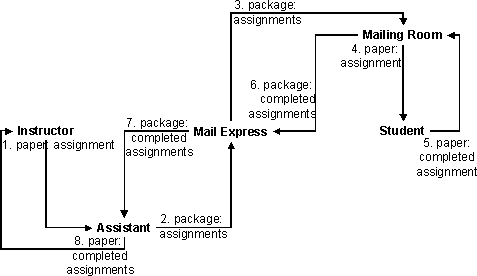
An information activity map graphically depicts the movement of information
between the agents—both people and technology—that participate
in a given work activity (or business process, as it is more commonly
referred to). For example, the map in Figure
1 depicts the process of mailing homework assignments to remote students
in a distance-education program. The agents are: instructor, assistant, mail
express, mailing room, and student. An arrow between two agents indicates an
information exchange. The arrows are annotated with the direction of the exchange
and the type of information exchanged.
Figure 1
An information activity map (Reprinted with permission from Flor, N. [2000],
Web Business Engineering, Addison-Wesley Longman)
Next, we look at how to use the map to identify ways of using the Web.


)