


| | |
|
 |
||
 |
ISDN and Data NetworkingA Technology OverviewBy Robyn Aber and Najib Khouri-HaddadThe Integrated Services Digital Network (ISDN) is becoming a mainstream telecommunications network that will serves a wide variety of users' needs. Experts call ISDN the telecommunications network of the 21st century, the foundation upon which to further build the information age. With its narrowband and broadband aspects, the ISDN data highway will evolve from today's switched telephone and dedicated leased-line networks to become a unified global network carrying voice, data, video, interactive pictures, and other services to homes and businesses. This network technology is becoming more available on a global scale and is providing a highly reliable and flexible infrastructure that can support high-bandwidth applications and a variety of services. Asynchronous Transfer Mode (ATM) switching technology, which is the basis for broadband ISDN, will be ideal for carrying various types of multimedia traffic in the next few years. Today, switched services and narrowband ISDN represent the first steps in the move toward digitized information. Narrowband ISDN as a means of switched WAN access in data networks is an attractive solution for branch or satellite locations, small businesses, or home offices because of the reliability that is inherent in its digital nature, its fast call setup (needed to support routing protocols), its flexibility in supporting different services, and its ability to support existing WAN protocols such as Frame Relay and X.25. ISDN provides a migration path for remote sites and individual remote users to meet the bandwidth demands of critical applications today and to evolve to higher speeds as needs change in the future. This paper presents an overview of narrowband ISDN technology from a data networking perspective and reports on its current deployment status worldwide. It compares ISDN with other existing and developing WAN services, covering point-to-point and switched, private, and public services. Next it looks at how ISDN addresses the growing need for remote LAN-to-LAN, remote node-to-LAN, and Internet and on-line information access connectivity. Finally, the paper provides information on ISDN planning and cost of ownership. An ISDN glossary is included at the end of the paper. Table of Contents:
What Is ISDN?The Integrated Services Digital Network (ISDN) is a currently available and growing public telecommunications network with a flexible infrastructure designed to integrate voice, data, video, images, and other applications and services. ISDN can be thought of as a replacement for the existing analog telephone network. Narrowband ISDN provides lower-speed services, from 56 Kbps to 2.0 Mbps; while broadband ISDN, based on the evolving cell-based Asynchronous Transfer Mode (ATM) technology, addresses high-speed service needs, from 2 to 600 Mbps. With ISDN, smaller regional and international sites can connect to enterprise networks and to one another much more cost-effectively than with dedicated leased lines. Dial-up ISDN links can replace leased-line connections altogether or be used as supplemental bandwidth for overflow and redundancy. Remote sites and individual remote users can dial in to central networks worldwide and enjoy reliable, high-speed digital connectivity to critical resources, or access and download the ever-increasing wealth of multimedia information on the Internet. ISDN Development HistoryThe International Telecommunications Union Telecommunications Standardization Sector (ITU-TSS), formerly known as the Comité Consultatif International Télégraphique et Téléphonique (CCITT), has defined ISDN as "a network evolved from the telephony Integrated Digital Network (IDN) that provides end-to-end digital connectivity to support a wide variety of services." Two key features distinguish ISDN from traditional telephone networks:
ISDN combines the coverage of a geographically extensive telephone network with the data-carrying capacity of digital data networks into a well-defined structure that can support simultaneous voice, data, video, imaging, and multimedia applications. ISDN technology has been available for years, but only in the past year have tariffs and deployment reached the point where it has become an affordable and viable WAN option, particularly in North America. In most of Europe and Japan, deployment is widespread; however, ISDN availability is just over the 70 percent mark in North America. ISDN is available in most North American metropolitan areas, while more rural regions still do not have access. Tariffing, as with any public service, has a large political/bureaucratic component. In North America, a Basic Rate Interface (BRI) is the most commonly used ISDN line and generally costs slightly more than a POTS (plain old telephone service) line. Service charges are slightly higher, but because less time is spent on-line, usage costs are lower. Given the advantages of a digital network, ISDN can be a cost-effective alternative to analog services. In some European countries, a Primary Rate Interface (PRI) access line is more affordable than BRI service. The Benefits of ISDN for Data-Intensive ApplicationsMore and more business, nonprofit, government, and academic enterprise network managers are realizing that integration of voice and data networks within the framework of international open standards reduces their costs and expands their capabilities. Integrated access to voice, video, and data services also paves the way for a whole new level of communication applications such as desktop videoconferencing.ISDN offers many benefits for organizations where data applications use public switched telephone network facilities. These benefits make ISDN particularly attractive for small regional and international branch sites that need to connect to central enterprise networks and to one another.
Comparing WAN Service Transmission RatesThe growing availability of ISDN means that remote users can now migrate from analog service to ISDN BRI for remote node-to-LAN connectivity for better-quality transmission at significantly higher speeds. Table 1 shows transfer times for a 20 Mbyte graphics file and a 1 Mbyte file transmitted by modem over long-distance analog lines, a Switched 56 connection, or two aggregated B channels from an ISDN BRI line (without compression).Data call connection with ISDN takes about one to four seconds to establish, while a Switched 56 or analog modem connection can take as long as 40 seconds. Fast call setup enables data applications to establish a connection on demand, transfer data, and disconnect, thereby minimizing usage charges. ISDN can also support concurrent voice, data, and video applications, whereas other switched digital services are designed to support only data. How ISDN WorksIn an analog network, a two-wire loop from the telephone company's local central office to the customer premises supports a single transmission channel, which can carry only one service--voice, data, or video--at a time. With ISDN, this same pair of twisted copper wires is logically divided into multiple channels. Long-distance traffic between telephone switching offices runs over T1/E1 (and higher) trunks that consist of four wires logically divided into multiple channels. ISDN uses the same channelized connection for long-distance transmission.
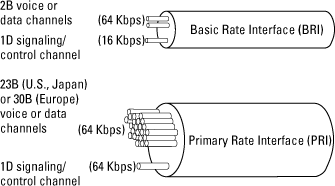
ISDN Logical ChannelsISDN defines two types of logical channels, distinguished by both function and capacity:
ISDN User Interface StandardsThe user connects to ISDN by means of a local interface to a "digital pipe." ISDN supports digital pipes of various sizes to satisfy different application needs. For example, a residential user might require enough capacity to handle a telephone and a PC. However, a remote site connecting to ISDN via an on-premises private branch exchange (PBX) or a bridge/router might require a higher-capacity pipe. At different times, the pipe might use varying numbers of channels, up to the capacity limit.The ITU-TSS has defined two ISDN user interface standards (shown in Figure 1):
Figure 1. BRI and PRI User/Network Interfaces
Rate AdaptionNon-ISDN equipment is often not capable of running at speeds of 64 Kbps. For example, a serial port on a PC might be restricted to 19.2 Kbps transmission. In such cases, a terminal adapter (TA) performs a function called rate adaption to make the bit rate ISDN compatible. Even though the transport speed of the B channel is 64 Kbps, the effective data rate is constrained to the throughput of the non-ISDN device.Terminal adapters employ two common rate adaption protocols to handle the transition. In Europe, V.110 is the most popular rate-adaption protocol, while North American equipment manufacturers use the newer V.120 protocol. Both standards support both synchronous and asynchronous transmission. Rate adaption also comes into play when access to 64 Kbps circuits is not available from one end of a connection to another. Since ISDN is currently not ubiquitous worldwide, telephone providers must sometimes create an end-to-end digital connection using Switched 56 Kbps digital services, even though the call originated on an ISDN link. In this case, the effective throughput of the link is limited to 56 Kbps. This type of rate adaption commonly occurs on international calls originating in North America or on calls that pass through multiple telephone carrier service areas. Most ISDN terminal equipment adjusts transparently to the lower rate.
Dynamic Bandwidth AllocationThe ISDN architecture allows for dynamic bandwidth allocation to boost effective transmission rates. Dynamic bandwidth or channel allocation is the logical aggregation of both B channels within BRI, for a total capacity of 128 Kbps; and any or all B channels for PRI lines, for an effective throughput of up to 1.536 Mbps in North America and Japan, and 1.92 Mbps in Europe.Also known as bandwidth-on-demand or inverse multiplexing, channel aggregation is often abbreviated as Nx64 Kbps, where N stands for the number of channels logically combined. In practice, network managers can adjust the inbound or outbound calling flow to respond to time-of-day or day-of-week needs. For example, a network manager could combine a number of channels to support a full-color, full-motion video conference during a busy weekday morning, and arrange to combine channels after workday hours for high-speed file transfers to remote sites anywhere.
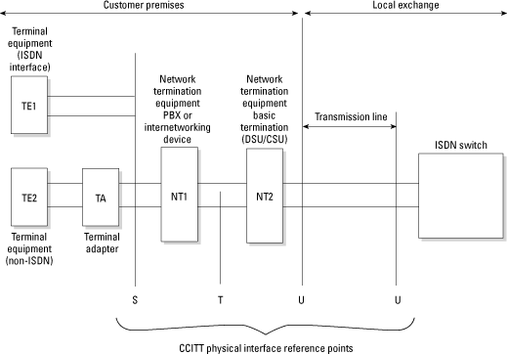
Multilink PPP Versus BONDing Channel Aggregation SupportMultilink PPP (ML-PPP) is an Internet Engineering Task Force (IETF) standard, specified by RFC 1717. It describes a layer 2 software implementation that opens multiple simultaneous channels between systems, giving users additional bandwidth-on-demand for additional cost. The ML-PPP standard describes how to split, recombine, and sequence datagrams across multiple B channels to create a single logical connection. It is written specifically for PPP, the TCP/IP link-layer standard for remote LAN and Internet access and ISDN use. Major ISDN service providers and ISDN equipment vendors like 3Com are including support for the ML-PPP standard in their products.The competing proposal for providing this functionality is called BONDing, which approaches synchronization between multiple streams at the bit level. BONDing was designed for video conferencing applications and will most likely require additional hardware for the end system. Because BONDing is hardware-oriented, it is efficient; but it is also expensive and inflexible, since once a pipe size is set, it cannot be changed until the session is finished. BONDing has been adopted more readily in the videoconferencing arena than in data networking. Physical Connections to ISDNThe following list shows the different types of functional devices that connect a customer site to ISDN services at the telephone carrier central office, as well as the ITU-TSS-defined interfaces that link them to network services (see Figure 2). Equipment that complies with these ITU-TSS-defined interfaces is guaranteed to be compatible with both ISDN and the other functional devices connecting to ISDN from the customer premises. There are two types of terminal equipment (TE): devices with a built-in ISDN interface, known as TE1, and devices without native ISDN support, known as TE2. Terminal equipment consists of devices that use ISDN to transfer information, such as a computer, a telephone, a facsimile machine, or a videoconferencing machine. Terminal adapters (TAs) translate signaling from non-ISDN TE2 devices into a format compatible with ISDN. TAs are usually stand-alone physical devices. The S interface is a four-wire interface that connects terminal equipment to a customer switching device, such as a PBX, for distances up to 590 meters. The S interface can act as a passive bus to support up to eight TE devices bridged on the same wiring. In this arrangement, each B channel is allocated to a specific TE for the duration of the call. Devices that handle on-premises switching, multiplexing, or ISDN concentration, such as PBXs or switching hubs, qualify as NT2 devices. ISDN PRI can connect to the customer premises directly through an NT2 device, while ISDN BRI requires a different type of termination. The T interface is a four-wire interface that connects customer site NT2 switching equipment and the local loop termination (NT1). An NT1 is a device that physically connects the customer site to the telephone company local loop. For PRI access, the NT1 is a CSU/DSU device, while for BRI access the device is simply called by its reference name, NT1. It provides a four-wire connection to the customer site and a two-wire connection to the network. In Europe, the NT1 is owned by the telecommunications carrier and considered part of the network. In North America, the NT1 is located on the customer premises. The U interface is a two-wire interface to the local or long-distance telephone central office. It can also connect terminal equipment to PBXs to support distances up to 3000 meters. The U interface is currently not supported outside North America. Figure 2. ISDN Functional Devices and Physical Interfaces
Bandwidth Allocation Control ProtocolWhile Multilink PPP (ML-PPP) provides greater bandwidth by allowing users to bundle multiple links into one logical link, it provides no way to manage the link. Once established, the multilink connection is unchangeable. The Bandwidth Allocation Control Protocol (BACP), now in draft status with the IETF, provides standards-based interoperability for managing dynamic bandwidth on demand. It works in conjunction with ML-PPP, providing a standard set of rules by which to change the ML-PPP bandwidth "bundle," channel by channel, on demand.BACP manages bandwidth by allowing two peers (both of which support BACP) to negotiate the addition or deletion of a link in a multilink bundle. These links could be voice or data channels in an ISDN line. While not limited to ISDN, BACP is especially useful in ISDN environments because ISDN is a high-speed medium that uses multiple channels. With BACP, large hunt groups over multiple channels are easy to manage. The benefits BACP offers are network flexibility, multivendor product interoperability, the ability to manipulate bandwidth to maximize network resources, and the ability for either end of a connection to manage the link, reducing operating costs.
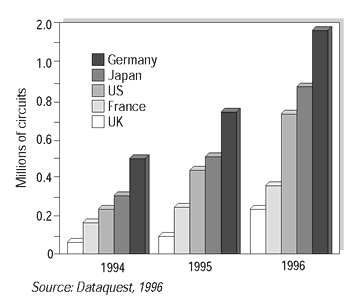
ISDN Deployment--A Status UpdateEurope is leading the world in the deployment of ISDN (see Figure 3). In North America, regional Bell operating companies (RBOCs) and interexchange carriers are aggressively stepping up their efforts to deploy ISDN technology to meet the growing demand for the service.For remote users in Europe and the Pacific Rim, where the ISDN infrastructure is more mature, ISDN has supplanted analog lines for remote node-to-LAN connectivity. Current ISDN installation in Europe is estimated at two million lines, and in Japan, more than 850,000 lines. The Japanese telecommunications giant NTT has committed to having 97 percent deployment by 1997. The stumbling block for these remote users has been the availability at the central site of ISDN-capable remote access servers, which are required for high-performance access to central site LAN resources. However, remote access servers that support ISDN are becoming more available worldwide. According to Dataquest, ISDN connections in the United States increased 81 percent from 1994 to 1995--from 247,000 to 448,000 BRI lines. Dataquest predicts that ISDN installations will increase another 69 percent this year, from 448,000 to 758,000 BRI connections. ISDN deployment in the U.S. varies widely among RBOCs and local exchange carriers (LECs). Although some carriers such as Pacific Bell and Bell Atlantic Corporation have upgraded more than 80 percent of their switches to ISDN technology, other carriers have as few as 46 percent of their switches upgraded. Figure 4 on shows the current and projected growth of average ISDN deployment by U.S.-based LECs. ISDN availability in Canada is much like that in the U.S. The service is predominately available in metropolitan areas through a variety of service providers, including members of the Canadian consortium, Stentor. Figure 3. Worldwide Installed ISDN Circuits
Figure 4. ISDN Switching Deployment Among U.S. Carriers
Comparing WAN ServicesInterconnecting remote sites into central-site LAN backbone configurations requires high-speed WAN links. Network managers have a number of existing and emerging WAN service options to choose from in addition to ISDN:
Some of these technologies and services are normally only cost-effective with larger site LAN-to-LAN connectivity applications. In contrast, ISDN is a viable option for both large and small remote LAN-to-LAN and remote node-to-LAN applications, as well as for Internet and on-line service access. This section compares the most common WAN data communication service options with ISDN. Choosing the best option involves evaluating such factors as service availability in locations requiring connectivity, types of network applications to be supported, and the internetworking environment. Table 2 on compares the types, line speeds, applications, and relative strengths and weaknesses of common WAN services. Analog Dial-Up ServiceAnalog dial-up service is a circuit-switched service that runs over standard telephone lines and is optimized for voice grade communication. It is the most ubiquitous transmission service providing connectivity throughout the world. Dial-up services are typically used when access to one or more remote devices does not justify the cost of a dedicated leased line. Typical applications include telecommuting, remote node-to-LAN internetworking, automatic dial-up as disaster recovery for a failed leased line, and Internet or other on-line information service access.In most cases, analog dial-up service providers will not guarantee support for specific data rates even if users purchase analog modems capable of handling up to 28.8 Kbps transmission rates; the maximum data rate is typically 19.2 Kbps. Little or no diagnostics are available from the service provider other than normal testing performed on residential and business lines. Also, line quality varies widely, and the amount of noise on a line has a direct bearing on the maximum data transmission rate. Table 2. (Part 1) WAN Services Comparison
Table 2. (Part 2) WAN Services Comparison
Switched 56 ServiceSwitched 56 service provides a low-cost alternative to private digital lines. Its operation is similar to standard dial-up analog service, except that the transmission is digital, at a rate of 56 Kbps, and it is used for data-only applications. Some service providers have begun to price this service at a higher cost to discourage its use in favor of other WAN options. However, Switched 56 can be used to link ISDN networks in places where ISDN is not yet deployed.X.25 Switched ServiceX.25 is perhaps the most widely used protocol standard. It has been used as a cost-effective way to provide interfaces between host systems and packet-switched networks for many years. Based on international standards, it provides synchronous data transmission over a public switched network at data rates of up to 56 Kbps. X.25 is most commonly used for terminal-to-remote host communication for applications such as order entry, electronic messaging, point-of-sales transactions, and credit card verification. ISDN supports the use of X.25 for packet mode service over the D channel.X.25's packet-switching technology automatically allocates access to available bandwidth and efficiently handles the bursty traffic inherent in LAN environments. X.25 also provides data security and automatic error detection and correction facilities, although the in-band facilities consume valuable data transmission bandwidth. However, X.25's slow speed prevents it from being an effective medium for higher-speed LAN or WAN applications. Point-to-Point Dedicated Leased ServicesToday the majority of worldwide WAN data connections still consist of private leased digital lines operating at 56 Kbps or 1.544 Mbps (T1 rates) in the U.S., and 64 Kbps or 2.048 Mbps (E1 rates) in Europe. High-speed point-to-point transmissions are used in environments where security and control are of primary importance. Point-to-point leased lines consist of a dedicated digital communication line between two points, and provide a fixed amount of bandwidth at a fixed speed. Typically, tariffs are based on a combination of the bandwidth provided and the distance between locations.For locations transferring controlled amounts of steady data traffic, leased 56- and 64-Kbps lines are popular because of their low installation and monthly rental charges. Private dedicated lines do not provide any inherent efficiencies in transmitting bursty traffic and are often underutilized, sometimes running at only 5 to 20 percent of total capacity. In addition, point-to-point, fully redundant interconnectivity requires expensive mesh topologies and customer premises equipment. Fractional T1 (E1 in Europe) is a high-capacity, private digital service designed to support multiple 64 Kbps channels. With this service, WAN subscribers can lease one of several 64 Kbps channels instead of the full T1 pipe. The service offers the same control, management, and security features as the full T1, and the same disadvantages, although costs are lower for fully meshed topologies. When data traffic between remote sites is intermittent or infrequent, ISDN and other switched services can be a cost-effective and reliable alternative to leased lines. Frame Relay ServiceFrame Relay, like ISDN, is a standards-based technology defined by both ANSI and ITU-TSS. Transmission rates range from 56/64 Kbps to 1.544 Mbps. Frame Relay can handle higher peak volumes than X.25 because of its use of high-speed DS-3 trunks and the low latency of the Frame Relay switching node. Frame Relay is typically used in LAN-to-LAN internetworking and IBM host access and data file transfer environments because its bandwidth-on-demand capability can handle bursty LAN traffic at relatively high speeds over long distances.Used in a remote communications path for an enterprise network, Frame Relay is totally transparent to users. Frame Relay technology uses standard WAN interfaces and CSU/DSUs and can coexist easily with ISDN and ATM services. The disadvantages of Frame Relay are that it can be as much as 12 times more expensive than ISDN and it requires a dedicated access line. Like SMDS, it is not yet widely deployed in Europe or in Asia and the Pacific Rim. Digital Subscriber Line ServicesDigital Subscriber Line (DSL) services include ADSL (Asymmetric Digital Subscriber Line), HDSL (High Bit-Rate Digital Subscriber Line), SDSL (Single-Line Digital Subscriber Line), and VDSL (Very High Bit-Rate Digital Subscriber Line). xDSL technologies use existing telephone company twisted copper pair plant. They enable the delivery of multimedia over wide area networks by providing wideband and broadband access speeds (from 64 Kbps to 52 Mbps).
Cable ServiceThe cable industry is beginning to build TCP/IP-ready WAN links that can support line speeds from 500 Kbps to 30 Mbps. Still in development, the initial target customer for cable WAN service is the residential computer user who wants faster on-line information access or interactive TV, or the teleworker who needs connectivity to an employer's central site LAN.Cable data networks are being designed to eliminate the lengthy dial-up and sign-on process inherent in analog services. The cable access device includes modem technology to convert the analog signal into digital data used by the computer. The network pipe itself is increasingly a fiber optic or hybrid fiber-coaxial cable designed for two-way communication in an asymmetric configuration. Data is carried downstream to the user over wide electromagnetic bands, while smaller bands carry commands and responses upstream to the cable provider's head-end. The disadvantages of existing cable networks are their reputation for unreliable service and the fact that bandwidth is shared; if one user ties up the WAN link with a high-bandwidth application, other users suffer. Cable companies are currently designing distributed network models that would connect smaller groups of users to multiple points of presence to solve this problem. Furthermore, unlike ISDN, cable networks are not currently optimized for two-way data communications (versus one-way broadcast transmission). ISDN is standardized worldwide, whereas cable addressing schemes and other internetworking standards have not yet been developed. The cable standardization process could take several years; ISDN is a standardized offering now. SMDSSMDS is a connectionless, cell-switched data transport service used to interconnect multiple-node enterprise LANs through the public telephone network. In fact, SMDS was designed to be the connectionless data service for ATM technology. SMDS is a standardized service that can be used as a backbone network to seamlessly connect Ethernet, Token Ring, and FDDI networks; and it supports all major networking protocols.SMDS's connectionless nature eliminates the need for carrier switches to establish a call connection between two points before data transmission. SMDS access devices pass 53 byte datagrams that include addressing information to a carrier switch that forwards the cells over any available path to their destination. Data travels over the least congested routes in an SMDS network, providing faster transmission, security, and greater flexibility to add or drop network sites. Between 200 and 500 customers in North America are using the service. In Europe and the Pacific Rim, service is just beginning to be deployed in about 16 countries. Internationally, SMDS is sometimes referred to as CBDS (Connectionless Broadband Data Service). ATMATM is an emerging technology for both local area and wide area networks for simultaneous transmission of voice, data, images, and video. Broadband ISDN is a set of technical standards and services based on ATM technology, defined by the ITU-TSS standards organization. ATM operates at speeds from 1.544 Mbps to 622 Mbps. In ATM, data is packaged into 53 byte cells, of which 5 bytes are used for header information. The 53 byte cell size is selected to provide effective performance for all types of traffic over a wide range of broadband speeds.ATM has some of the advantages of narrowband BRI and PRI ISDN, with the significant added advantage of almost unlimited transmission speeds. However, many details of the ATM standard implementation are still evolving, and ATM WAN service is not yet widely available. Evaluating WAN Service Cost-of-Ownership OptionsThis section presents a framework for evaluating which WAN service or combination of WAN services best fit the internetworking needs of your enterprise network. The evaluation process involves comparing the advantages and disadvantages of each WAN service, and estimating the cost of ownership for each service for your specific applications. To perform a cost-of-ownership analysis, follow the steps below.1.Define the set of WAN service alternatives and the associated cost elements to be compared:
2.Compare the alternatives using a specified measure of the relative worth or value of each factor; for example:
3.Define the planning horizon--the window for which the economic performance of each WAN service alternative will be viewed. 4.Develop a cash flow profile comparing expenditures using existing networking methods and expenditures with the potential new methods. 5.Select the preferred alternative after evaluating all of the weighted cost-value factors. 6.Communicate your findings to upper management in business and financial terms that can be understood and accepted. ISDN Data Networking ApplicationsISDN's high throughput capacity with dynamic bandwidth allocation features, signal quality, reliability, flexibility, fast call setup, and attractive tariffs make ISDN an excellent, cost-effective medium for the following major networking applications:
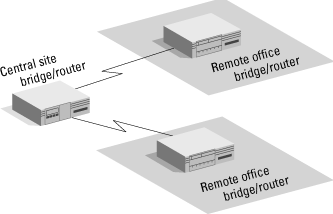
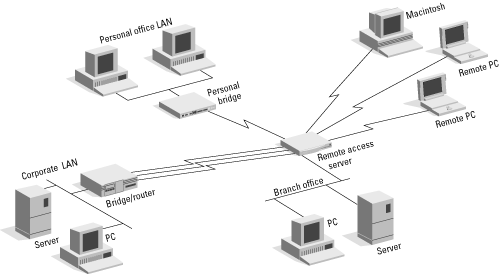
Remote LAN-to-LAN and LAN-to-Host InternetworkingAs shown in Figure 5, a growing number of small to medium-sized remote sites are now connecting to central site enterprise network backbones to access centralized information on mainframes or client-server databases or to exchange electronic mail. The small number of users at these remote sites does not usually warrant the bandwidth and expense of a dedicated leased line to the central site. Users at remote sites might have a single local LAN for sharing common resources such as printers, facsimile machines, and application servers.These smaller remote sites might also require dial-up access to central site network resources just for individual users. In either case, exchanging e-mail or retrieving information from central computers requires at least a temporary WAN connection. ISDN and other switched services are well suited for on-demand remote LAN-to-LAN configurations since they provide a telephone circuit only when information needs to be transferred. And some internetworking devices have the intelligence to schedule these connections when telephone rates are more economical, for added cost savings. Figure 5. Remote LAN-to-LAN Internetworking
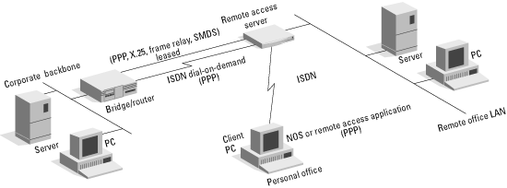
Dial-on-Demand Internetworking ApplicationsRemote users that need access to the central site LAN might reach it more economically through network links provided by a local LAN site. For example, to save long-distance access charges, mobile users can dial in to a local LAN and allow the network to route the traffic to the final destination, which might be in another location or even in another country. Depending on the traffic pattern between the LANs, the connection between the local and destination LAN can be leased or dial-up. For dial-up connections, the local LAN initiates the connection on demand and aggregates multiple circuits to offer the appropriate level of service, as shown in Figure 6.With ISDN's fast call setup capability, remote LAN-to-LAN or remote node-to-LAN access can take advantage of dial-on-demand during an individual session. When there is no client data traffic destined for the LAN, the client can disconnect an ISDN WAN link transparently to the running application to save dial-up charges. The application continues to see a logical link to the LAN through a process known as "spoofing." When communication with the LAN is required, the remote client automatically reestablishes a dial-up session and passes the data traffic over the WAN. Figure 6. Dial-on-Demand Internetworking Application
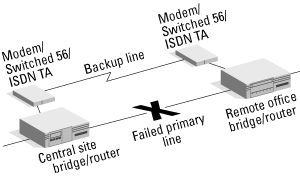
Redundancy and Overflow Internetworking ApplicationsMission-critical applications have strong reliability and availability requirements that make fault tolerance an important criterion in network design. Redundancy is usually the preferred way to achieve fault tolerance. For example, many organizations use a leased line as the primary WAN connection to ensure constant availability of a data path, while leasing another line to serve as a backup. This is an expensive solution, however, since the back-up line is needed only when the primary line malfunctions, yet organizations pay the monthly charge for the redundant line whether or not it is used.A dial-up connection, such as an ISDN BRI line, is a more affordable back-up solution to a primary leased line. As shown in Figure 7, the dial-up line is automatically activated by the central internetworking device when a failure occurs on the primary line, with no apparent degradation of service in the network. If the primary line is a high-speed pipe running at T1 or E1 rates, several lower-speed dial-up circuits can be aggregated to achieve comparable high-bandwidth capacity. ISDN can also be used to carry the overflow of data connections when the data load increases. When the primary line reaches maximum capacity, the bridge or router can detect the bandwidth bottleneck, dial one or more ISDN circuits in real time, and route overflow traffic through the B channels. Figure 7. Redundant WAN Link Internetworking Application
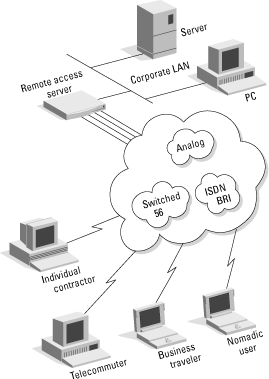
Remote Node-to-LAN InternetworkingThe concept of remote node-to-LAN internetworking can be extended to a single user in a remote location, as shown in Figure 8. The user calls in to a remote access server from home or another location via ISDN BRI to connect to host servers or mainframes at the central site enterprise network backbone. The remote access server makes the remote user appear as a locally connected client on the LAN, with all the attendant services and privileges.Remote node-to-LAN internetworking opens new avenues of communication for employees who travel extensively, work at home, or require after-hours access to the office. At the central site, the internetworking device receives incoming data calls from various locations through pools of dial-in lines, provides security authentication and validation of callers via login procedures, and routes the calls over the central site network. Alternatively, the internetworking device can hang up after identifying the caller and call back later for security or economy. With ISDN, remote and mobile computer users can get secure and reliable access to multiprotocol LANs and SNA mainframe resources. ISDN's fast call setup is ideal for the point-of-sale transaction-based networks of small businesses and retailers that need immediate responses to credit and debit card authorization, and for medical center and other health-care providers that need immediate verification of health-care eligibility. Using ISDN, the verification process typically takes less than one second compared to the 15 second or more wait experienced with 14.4 Kbps analog modem-based systems. ISDN's high speed and rapid response times offer a competitive advantage in responsive customer service. Figure 8. Remote Node-to-LAN Internetworking Application
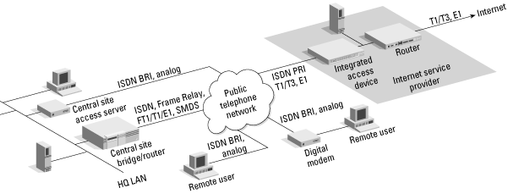
Internet and On-Line Information AccessToday, thousands of business, government, research, and educational organizations are linked to the Internet through dedicated high-speed lines that range from 56 Kbps to 1.544 Mbps. However, millions of residential and small-site users have linked their PCs or workstations to the Internet using analog dial-up modems, either through direct connections or through links to the e-mail gateways of major information service providers. The low-speed analog-to-digital dial-up connections make it virtually impossible for these users to access the rich array of video, graphics, and televised discussion group applications offered on the Internet.As shown in Figure 9, ISDN's high-speed service solves the bandwidth access problems for these remote users, as well as for Internet users on an enterprise LAN. Remote users can connect to the Internet directly or dial in to the central site access server and gain access to the Internet through the central site LAN, taking advantage of its faster link to the Internet service provider. More and more public and private Internet service providers are tapping this market and supporting ISDN gateways that provide 64- and Nx64-Kbps access to the Internet or other on-line information access services. Figure 9. Internet Access Internetworking Application
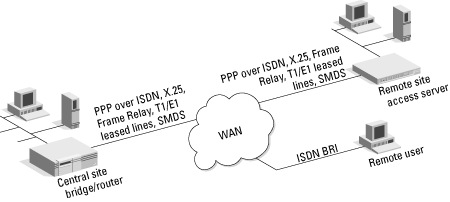
ISDN Interoperability with WAN ServicesAs defined, ISDN B channels are bearer channels for carrying any type of digital information--voice, data, video, bits of any sort. These channels also provide 64- and Nx64-Kbps access to a wide range of network services, including other WAN services.As Figure 10 shows, client-to-LAN applications such as remote node-to-LAN internetworking are point-to-point applications. LAN protocols such as IP and IPX, transmitted from a client application or network operating system, are transported over the dial-up ISDN link using the Point-to-Point Protocol (PPP) or Multilink PPP (ML-PPP). Once the data packet reaches the LAN, the remote access server can route it as is using PPP, or repackage the data and route it over the backbone using any available network service, including X.25, Frame Relay, or SMDS. The service is entirely transparent to the B channel. The remote access server can also establish a LAN-to-LAN connection on demand via a dial-up link, and route the data packet using PPP or ML-PPP. Figure 10. ISDN Access to Other WAN Services
Planning and Installing an ISDN ServiceBefore you call up your network service provider and order your ISDN service, there are several service, cabling, and equipment decisions to consider. For example, the type of ISDN delivery service, type of BRI wiring alternatives, ISDN cost-of-ownership information, and the type of ISDN equipment required for your configurations must be determined. This section describes these ISDN implementation issues.
ISDN ServicesTelco service providers deliver ISDN service from the central office ISDN digital switch in one of three ways:
ISDN BRI Wiring AlternativesISDN uses the same twisted-pair copper telephone wires already in place in most corporate, campus, medical, or government facilities and residences for analog telephone service use. More than 80 percent of these lines can be used successfully for ISDN BRI connections without special conditioning. However, depending on the ISDN line usage requirements and the number of existing handsets or other installed devices, you may want to consider two wiring alternatives:
ISDN Customer Premises Equipment RequirementsUsers with remote LAN internetworking environments will need one or more of the following ISDN customer premises equipment:
Residential and small-site users will need some of the following special equipment to access ISDN lines:
Table 3. 3Com ISDN Product Offerings
ISDN Ordering CodesTo make the purchasing and coordination of ISDN vendor equipment and ISDN carrier services easier for potential users in the United States, service providers and equipment vendors, under the auspices of the Corporation for Open Systems International, developed ISDN ordering codes (IOCs). Bellcore has recently assumed responsibility for administering IOCs and their associated testing procedures.The ISDN ordering codes are a standardized list of network services associated with specific U.S.-based ISDN customer premises equipment for a specific application. Seventeen standard capabilities were defined based on the most popular network configurations -- combinations of features, services, and network parameters--already in use by thousands of ISDN customers across the country. To date, more than ten international service providers and over 40 CPE vendors support ISDN ordering codes. Specifying the CPE vendor's equipment ISDN ordering code when placing an order with an ISDN service provider circumvents line provisioning or other complexities. The standard code ensures that the line will work properly with the equipment and will be provisioned more quickly and accurately. A vendor should be able to provide the IOCs for its products to its U.S.-based ISDN users. Bellcore alerts carriers to the products and switch translations these IOCs represent. The North American ISDN User's Forum (NIUF) Ad Hoc Group on the Simplification of ISDN Ordering, Provisioning, and Installation has been focusing on developing easier ways for customers to order ISDN service. The EZ-ISDN codes that they have proposed reduce even further the number of IOCs and are geared toward assisting mass market users of ISDN.
ISDN ConfigurationThe Vendors' ISDN Association (VIA) has been formed as a nonprofit corporation dedicated to simplifying and accelerating the availability of interoperable ISDN customer equipment solutions and driving the development of market-based application requirements based on open standards. The initial focus of the VIA, of which 3Com is a founding member, is on automated ISDN configuration capabilities that can eliminate manual configuration.
SummaryNew high-speed digital switched services from public telecommunications companies provide cost-competitive WAN connectivity alternatives for today's global organizations. ISDN provides a flexible, high-bandwidth alternative to analog dial-up and dedicated leased line services for remote LAN-to-LAN, remote node-to-LAN, remote terminal-to-host, and Internet and on-line service access internetworking applications.A single BRI connection can link remote users or smaller sites to a central LAN site with simultaneous voice and data communication. Switched digital network access is particularly well adapted to users in remote locations who often cannot justify the cost of a dedicated connection to central site LANs. In addition, ISDN's high-speed capabilities make it a cost-effective option for organizational and residential users who want to take full advantage of the information-rich resources on the Internet and World Wide Web. Evaluating WAN services for your enterprise network entails weighing the advantages, limitations, and cost of ownership of each option against your company's short- and long-term internetworking needs. ISDN provides some clear advantages for switched WAN access: the reliability and built-in security of digital technology, fast call setup for data applications, interoperability with other services such as Frame Relay and X.25, and cost-effective integrated support of voice, data, and video services on a call-by-call basis. ISDN also delivers the bandwidth demands of critical applications today, while providing a migration path to the higher speeds of broadband ISDN using ATM switching as application demands grow in the future. Successful ISDN deployment involves identifying and understanding all service provisioning and equipment configuration and maintenance options, as well as other cost-of-ownership issues, in advance of implementation. Careful planning will ensure that your ISDN installation runs smoothly and that the network system you've implemented meets your organization's short-term and long-term WAN connectivity requirements.
ISDN Glossary
About the AuthorsRobyn Aber is director of business development for 3Com, responsible for the company's worldwide remote networking strategies and their implementation. She has more than 21 years' experience in product management and marketing, strategic planning, market research and analysis, and information systems management. Before joining 3Com in 1994, Robyn worked at Bellcore for 11 years. Prior to that she was an MIS manager at Sandoz Pharmaceuticals.Robyn is a board member of the Vendors' ISDN Association, is active in the California ISDN Users Group and the ATM Forum's Residential/Small Business sub-working group, and represents 3Com at xDSL standards organizations. Robyn holds an M.B.A. in marketing and international business from New York University and an M.S. in information science and systems from the University of Illinois. Najib Khouri-Haddad joined 3Com in 1992 as the product manager for remote office products in the network systems division. Today he is product line manager in the Primary Access division, managing the AccessBuilder 5000 and remote access server products. Previously Najib worked at Rolm, a business communications systems company. Najib holds an M.A. in engineering management from Stanford University and an M.S. in electrical engineering and computer science from the University of Michigan.
For more information on 3Com's ISDN product offerings, contact your local 3Com representative by calling 1-800-NET-3COM. Outside the United States and Canada, call your nearest 3Com sales office.
3Com, AccessBuilder, NETBuilder, and NETBuilder II are registered trademarks of 3Com Corporation. 3ComImpact, OfficeConnect, and SuperStack are trademarks of 3Com Corporation. Other brand and product names may be trademarks or registered trademarks of their respective owners. All specifications are subject to change without notice.
500606-002
|
||||||||||||||||||||||||||||||||||||||||||||||||||||||||||||||||||||||||||||||||||||||||||||||||||||||||||||||||||||||||||||||||||||||||||||||||||||||||||